
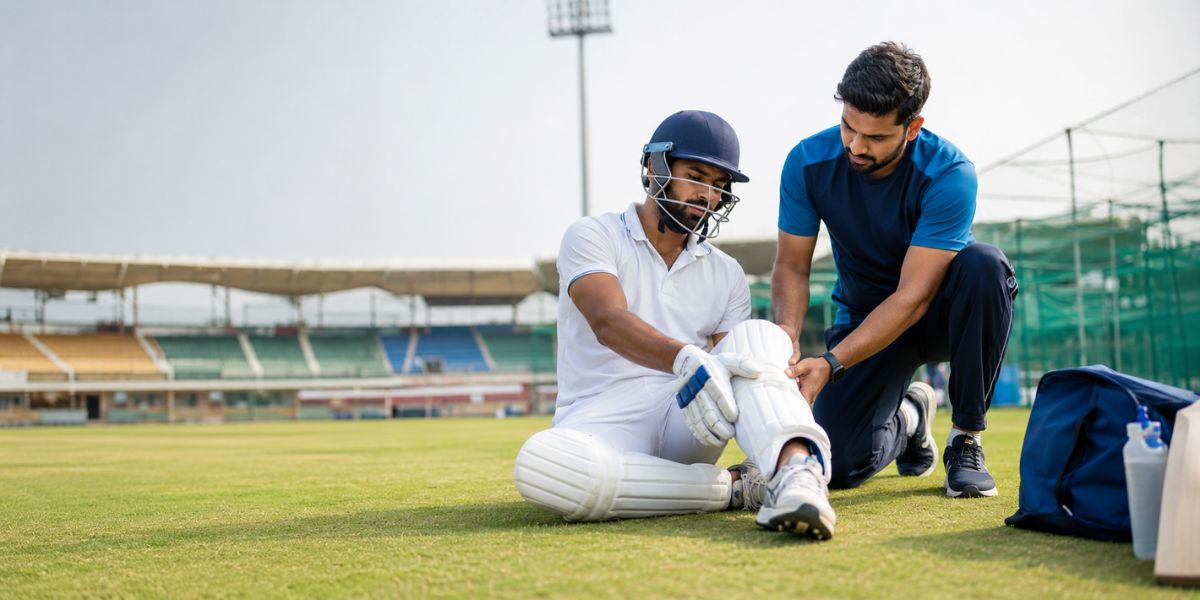
Cricket looks effortless when a Batter times a cover drive or a Fast bowler delivers at pace, but the sport places considerable demands on muscles, joints, bones, and the spine. Common cricket injuries can develop suddenly after a fall or collision, or gradually through repetitive Bowling, throwing, running, and high Training load.
For recreational and competitive players in India, understanding injury warning signs can make a meaningful difference. Dr Rajneesh Kant approaches sports-related problems with assessment, movement-based rehabilitation, and individualized care rather than treating pain in isolation.
Understanding Common Cricket Injuries and Their Causes
Cricket injuries generally fall into two broad categories: acute injuries and overuse injuries. Acute problems occur suddenly, while overuse problems develop when tissues repeatedly experience stress without enough recovery.
Research has consistently identified Bowling as a major source of injury, while Fielding, wicketkeeping, and Batting also create significant physical demands. Recent research continues to highlight lumbar stress injuries, hamstring problems, shoulder conditions, and hand injuries among cricket athletes.
Acute and Overuse Injuries in Cricket
Acute injuries may include a Sprain, Fracture, Dislocation, Concussion, Head injury, or sudden Muscle strain. Overuse problems can involve Tendinitis, a Tendon injury, Stress fracture, or persistent inflammation.
Typical cricket injury risk factors include:
- Sudden increases in Training load
- Poor Workload management
- Inadequate Warm-up or Recovery
- Reduced Mobility or Flexibility
- Poor Technique or Bowling action
- Previous injury
- Insufficient Strength training and Conditioning
Common Cricket Injuries by Body Region
The body region affected often depends on the player's role, technique, and workload. Common cricket injuries include soft-tissue problems, joint injuries and bone stress injuries.
Hamstring strain is particularly important in modern cricket, while lower-back problems remain a major concern for Fast bowlers. Research also identifies shoulder, hand, wrist, finger and thigh injuries across different playing groups.
Common examples include:
- Cricket shoulder injuries: rotator cuff irritation, Tendon injury, and shoulder pain
- Cricket back injuries: muscular pain and lumbar stress injuries
- Cricket knee injuries: ligament injury, ACL injury, and knee pain
- Cricket ankle injuries: ankle sprain and Foot injury
- Cricket hamstring injuries: hamstring strain during Sprinting or acceleration
- Cricket muscle injuries: strains involving the Hamstring, quadriceps, or Calf
- Cricket ligament injuries: sprains affecting stabilising ligaments
- Cricket tendon injuries: Tendinitis and Achilles tendon problems
- Cricket overuse injuries: gradual problems associated with repetitive movement
- Cricket acute injuries: sudden injuries from impact, landing or rapid movement
Common Cricket Injuries in Players by Role
Different roles create different physical demands. Bowling has historically accounted for a substantial proportion of cricket-related injuries, while fielding exposes players to Sprinting, Diving, catching, and sudden changes of direction.
Injuries in Bowlers, Batters and Fielders
- Fast bowlers: Pace bowling places substantial demands on the lumbar spine, lower limbs and trunk. Bowling workload, technique and recovery are especially important.
- Spin bowlers: Spin bowling may involve repetitive shoulder, elbow, wrist and lower-limb movements, particularly during long spells.
- Batsmen and Batters: Cricket injuries from batting may involve the wrist, hand, fingers, ribs, shoulder or lower back, especially after impact or awkward movement.
- Wicketkeepers: Squatting, repeated standing, lateral movement and Diving can contribute to knee, ankle, hip and lower-back symptoms.
- Fielders: Cricket injuries from fielding commonly involve sudden running, sprinting, throwing, catching, and Diving. Hand, wrist, finger, and lower-limb injuries can occur.
Cricket Injury Symptoms and When to Seek Help
Pain after intense exercise is not always an injury, but persistent or worsening symptoms deserve attention. Cricket injury symptoms may include Pain, Swelling, Bruising, Muscle soreness, weakness, or Reduced mobility.
Players should arrange an assessment when:
- Pain persists despite Rest
- Swelling increases or repeatedly returns
- Movement becomes restricted
- Strength suddenly decreases
- A joint feels unstable
- Back pain occurs repeatedly during Bowling
- A head impact causes confusion, dizziness, or unusual symptoms
- You cannot safely perform normal cricket movements
A proper cricket injury diagnosis considers the history, physical examination, movement patterns, and, when appropriate, imaging or referral. The goal is to identify the cricket injury causes rather than simply suppress symptoms.
How to Prevent Cricket Injuries
Good Cricket injury prevention begins before the first delivery. Players should build physical capacity gradually and match their conditioning with the demands of their playing role.
A practical prevention routine can include:
- Cricket warm-up exercises: light running, mobility drills and progressive sport-specific movements
- Cricket stretching exercises: appropriate flexibility work after warming up
- Strength training: focus on the trunk, hips, legs and shoulders
- Mobility: maintain controlled movement at key joints
- Conditioning: prepare for the running demands of matches
- Technique: review Bowling action, Batting mechanics and Throwing technique
- Protective equipment: use a Cricket helmet, Batting pads, Gloves and suitable protective gear
- Proper footwear: choose shoes appropriate for the playing surface
These measures support Cricket fitness and injury prevention without guaranteeing that injury will never occur.
Workload Management for Cricket Players
Workload deserves particular attention in Fast bowlers and developing players. Evidence from elite and academy cricket shows that Bowling is strongly associated with injury burden, with the lumbar spine an important area of concern.
Training should progress rather than jump suddenly. Coaches and players can monitor:
- Bowling workload and spell length
- Match and training frequency
- Changes in playing format
- High-intensity Running
- Strength and Conditioning sessions
- Sleep and Recovery
- Previous injuries and current symptoms
Young players require particular care because developing bodies may respond differently to repetitive loading. Recent research also highlights the need for more injury-prevention research across adolescent and female cricket populations.
Cricket Injury Treatment and Rehabilitation
Treatment depends on the injury, its severity, the player's age, and the demands of their role. Cricket injury treatment may involve temporary activity modification, physiotherapy, progressive Strength training, mobility work, and medical referral when necessary.
For players experiencing persistent knee symptoms, Knee Pain Physiotherapy in Mumbai can help identify movement and strength limitations and develop an appropriate rehabilitation plan.
Similarly, Shoulder Pain Physiotherapy in Mumbai may be useful for players whose throwing, bowling, or batting is affected by persistent shoulder symptoms.
Midway through recovery, the focus should shift from simply reducing Pain to restoring capacity. Dr Rajneesh Kant emphasizes individualized rehabilitation and movement-focused care, with treatment plans adapted to the person's condition and functional goals.
The same principle applies to Back Pain Physiotherapy in Mumbai, particularly when lower-back symptoms interfere with Bowling, running, or everyday movement. A structured assessment can help determine whether symptoms are muscular, movement-related, or require further medical evaluation.
Cricket Injury Recovery and Return to Play
Cricket injury recovery time varies considerably. A minor Muscle strain may recover relatively quickly, while a Fracture, significant Ligament injury, Stress fracture, or serious Tendon injury can require a substantially longer rehabilitation period.
A safe Return to play should consider function rather than the calendar alone. Players should progressively demonstrate:
- Pain-controlled movement
- Restored Mobility and Flexibility
- Adequate strength
- Sport-specific Conditioning
- Confidence with running and changing direction
- Gradual return to Batting, Bowling, throwing, or Wicketkeeping
- Appropriate workload tolerance
Cricket injury rehabilitation should therefore be progressive. Returning too early because symptoms temporarily improve can increase the risk of recurrence.
Choosing the Right Cricket Injury Management Approach
Players searching for the Best Physiotherapy in Mumbai should look beyond marketing claims. A good sports rehabilitation approach should include assessment, clear communication, individualized exercises, measurable progress, and appropriate referral when a condition falls outside physiotherapy.
For ongoing shoulder, back or knee problems, Best Physiotherapy in Mumbai should mean care that addresses function as well as symptoms. Physiotherapy may be combined with other appropriate medical services when required.
The clinic's public-facing materials also describe care provided to several well-known Indian personalities, including Lalu Prasad Yadav, Tejashwi Yadav, Pankaj Tripathi, Khesari Lal Yadav, Dinesh Lal Yadav “Nirahua,” Kumar Sanu, Manoj Tiwari, Pawan Singh, Paritosh Tripathi and Rabri Devi. These examples should not be treated as proof that any particular treatment is suitable for every athlete; each cricket player requires individual assessment.
Conclusion: Build a Safer Path Back to Cricket
Cricket injuries and prevention should be part of every player's long-term performance plan. Whether the problem is a hamstring strain, shoulder injury, lower back pain, knee injury, ankle sprain, or another sports injury, early attention can help prevent a manageable problem from becoming a prolonged setback.
The key principles are simple: warm up properly, develop strength and mobility, manage workload, respect pain, use protective equipment, and progress rehabilitation carefully. Cricket injury recovery should always be guided by the injury's severity and the player's functional demands.
If persistent pain is affecting your training or performance, consider a professional assessment instead of repeatedly playing through symptoms. Dr Rajneesh Kant and the clinic team provide physiotherapy, sports-injury rehabilitation, and musculoskeletal care in Mumbai. You can contact the clinic to learn more about assessment and treatment options.